Tampilkan postingan dengan label mc. Tampilkan semua postingan

Rabu, 06 Mei 2009

AP exam review: 2004 B1, Roller Coaster


It's time for that final AP exam review. Today's post gives a multiple choice review exercise based on an old AP exam question; tomorrow I'll describe my final classday activity.

As I've discussed before, just doing an AP practice problem does not provide sufficient review. Practice problems must be followed up somehow. Usually I have students do corrections on what they missed. But for a fun change of pace in the spring, I get out my classroom response system (my "clickers") and run a little contest for extra credit.

Before I go on, please note that (a) this contest works just fine without "clickers" -- just have the groups write their answer really big on a piece of paper and hold it over their heads. And, (b) this type of review is not confined to AP physics. AP questions can be carefully selected, or edited, for use with your general high school physics class. You can use this as final exam review.

How the contest works
This contest is based on problem 1 from the 2004 AP physics exam. For lawyerly reasons I can't post the actual question here, but you can get it via this link: http://apcentral.collegeboard.com/apc/members/exam/exam_questions/2007.html#name04


First, I have the students do this problem to the best of their ability on their own. This usually means as a quiz.

Next, I use http://random.org/ to divide the class into teams of two. Each team gets one clicker

Now, I ask the multilpe choice questions that you see below. I ask them one at a time, giving at least 60 seconds for the teams to discuss the correct answers. After the 60 seconds, I collect responses, and then go over the correct answer

Scoring: Each team gets one point for the correct answer, and one more point for each group who doesn't get it right. There are a bazillion ways to score a contest like this... I've found that this particular scoring makes students less willing just to listen to the smartest students without thinking for themselves. I get good arguments amongst the class, which is what I'm after.


Here are the questions I ask:

1. At which labeled point does the car attain its maximum speed?
(A) I
(B) II
(C) III
(D) IV
(E) V

2. To calculate the value of the car’s maximum speed, do we use kinematic equations (vf = vo + at and so on) or conservation of energy?
(A) Kinematics must be used
(B) Conservation of energy must be used
(C) Either kinematics or energy conservation may be used
(D) Neither kinematics nor energy conservation will produce a solution

3. What general formula for potential energy do we use here?
(A) mgh
(B) ½mv2
(C) ½kx2
(D) qV
(E) (3/2)nRT

4. What general formula for kinetic energy do we use here?
(A) mgh
(B) ½mv2
(C) ½kx2
(D) qV
(E) (3/2)nRT

5. To calculate the speed at point B, which of the following formulas is correct?
(A) mg(90 m) + 0 = 0 + ½mvB2
(B) mg(50 m) + 0 = 0 + ½mvB2
(C) mg(40 m) + 0 = 0 + ½mvB2
(D) mg(30 m) + 0 = 0 + ½mvB2
(E) mg(20 m) + 0 = 0 + ½mvB2


Which of the following free body diagrams correctly represents the forces acting on the car when it is upside down at point P?
(A) A
(B) B
(C) C
(D) D
(E) E

What is the weight of the car?
(A) 700 N
(B) 7000 N
(C) 700 kg
(D) 7000 kg

What is the magnitude of the NET force on the car?
(A) mg
(B) Fn
(C) Fn – mg
(D) Fn + mg

What is the magnitude of the car’s acceleration?
(A) 0 m/s2
(B) 28 m/s2
(C)[(28 m/s)2 / (20 m)]
(D) 10 m/s2

What is the direction of the car’s acceleration?
(A) Down
(B) Up
(C) Left
(D) Right

Imagine changing the (still frictionless) track such that point B is still 50 m off of the ground at the top of a circular loop, but the circular loop has only a 15 m radius. What happens to the speed of the car at point B?
(A) It is smaller than before
(B) It is larger than before
(C) It is the same as before

Consider the same track with NON-negligible friction. What is true about the speed at point B now?
(A) It is smaller than 28 m/s.
(B) It is larger than 28 m/s.
(C) It is still 28 m/s.

How could we adjust the track with NON-negligible friction so that its speed at point B is the same as we calculated previously?
(A) Make the radius of the circle smaller
(B) Make the radius of the circle bigger
(C) Make point B closer to the ground
(D) Make point B higher off the ground

Selasa, 24 Februari 2009

Rainwater in a cart – why does the cart slow down?

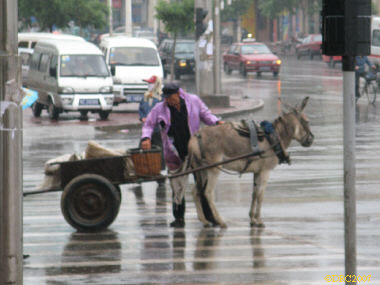
A multiple choice question on, I think, the 1998 AP B exam, asks about rainwater falling into a moving cart. If the rain falls vertically, does the cart speed up, slow down, or maintain constant speed? And is that because of conservation of momentum or energy? (Note that we're not considering a donkey-pulled cart, just a freely-rolling cart.)

The answer is that the cart slows down due to conservation of momentum. Mechanical energy is not conserved in this situation because much of the kinetic energy of the water dissipates as thermal energy upon splashing in the cart. And since momentum is conserved, the additional mass added by the rainwater causes the cart’s speed to drop in order to maintain the overall mass×velocity.

My students often miss the question on first pass. They’re not really sure what’s conserved and why. “Conservation of energy” is so ingrained in their consciousness – both from a physics and an environmental standpoint – that they nearly automatically choose an answer with the magic phrase.

I asked this question on my first trimester exam back in November. Anyone who missed the question had to write a test correction. Problem was, a lot of folks still made poor arguments. Some thought that energy was conserved. Some thought the cart would speed up because of the water’s initial speed – they didn’t separate vertical from horizontal momentum. I knew many of these folks were ripe for making the same mistake again.

I’m not averse to hammering an idea over and over. That’s the main idea of the “Less is More” teaching philosophy – you don’t have to assign that much work, but you must hold students thoroughly accountable for understanding everything that is assigned. So, I told the class to expect a quiz based on this question. Below is the quiz I assigned...


1. An open cart on a level surface is rolling without frictional loss through a vertical downpour of rain. As the cart rolls, an appreciable amount of rainwater accumulates in the cart. Thus, the cart and water can be treated as if they are colliding.

(a) Which of the following is conserved in this collision? Circle all that apply.

Kinetic energy
momentum
velocity
acceleration


(b) What is the horizontal velocity of the rainwater before it lands in the cart?


(c) What will happen to the speed of the cart? Explain in one or two sentences.


GCJ

(Top photo from donchesnut.com.)


Sabtu, 21 Februari 2009

Where do you find good multiple choice questions?


Yesterday I described my nefarious scheme for getting students to study for the trimester exam by means of a multiple choice extra credit exercise. I also indicated that the multiple choice portion of the AP trimester exam will include 23 multiple choice questions. During the trimester, I give multiple choice quizzes two-three times a week. And you will find out soon that, next month, my AP class will be plowing through many, many multiple choice exercises in preparation for the May AP exam.

You will find that I BELIEVE in the utility of a well-constructed multiple choice item to evaluate students’ understanding of physics concepts, and to help students confront their own misconceptions. Sure, many physics skills are better tested with free response items; I willingly concede that if the majority of your assessment is done with multiple choice, you get a biased account of a student’s physics ability. Too often, though, teachers and administrators dismiss multiple choice merely as the first and last resort of a lazy instructor.

Such is the pejorative connotation of multiple choice that when I was the first Woodberry teacher to acquire a scantron machine, I hid it in my office in order to avoid the inevitable soapboxing from my colleagues outside the science department. The machine is still in my office… but after eight years it’s become an open secret. At exam time I willingly help out the rebels from humanities departments who sneak down to use the machine.

Now, don’t think that I’m encouraging slack teaching. In order to be useful, a multiple choice question must be well-constructed. Writing good items is not a trivial exercise, as I’ve discovered numerous times. Not much is more embarrassing than going over a quiz in which the correct answer doesn’t appear in the choices, or in which the answers are not clearly different from one another. Initially, the front-end work necessary in finding or writing multiple choice questions cancels out the back-end work saved by grading via scantron machine.

(As an aside, my English department colleague El MolĂ© invented the principle of conservation of exam workload – in writing an exam either you have to spend enormous time writing multiple choice or grading essays. The total time spent on the exam process is conserved regardless of how the exam is structured.)

Perhaps I’ve convinced you of the utility of multiple choice. Multiple choice practice might be useful and wonderful, but this post begs an obvious question – where in the heck do you find enough good multiple choice items for use in your class?

That’s a tough one, but I have a few suggestions. First of all, get good at evaluating the quality of an item. When you assign a question on a test or quiz, rewrite it immediately or throw it out if it didn’t work quite the way you thought. When you happen to see a good question somewhere, write it down before you forget.

The best source of multiple choice items is the College Board itself. A number of full-length AP exams have been released. Go attend an AP physics workshop, contact an AP physics consultant, or go to collegeboard.com and look for released exams. (Neither I nor anyone else is allowed to post content directly from an AP exam, as that would infringe on the AP program’s copyright and a plague of lawyers would descend upon me.) The College Board also writes the SAT II physics test, which consists of well-written and vetted multiple choice questions. Take a look at a sample test and use some of those problems.

I do not recommend most commercial AP or SAT II preparation books. It’s rather pathetic how out of touch most of these books are with the level or content of the exams, or sometimes even with what physics is all about. Similarly, I strongly recommend against fly-by-night companies such as the ubiquitous “D&L marketing” who send flyers peddling AP physics multiple choice tests.

Two books, though, are in fact useful. One is my own,
5 Steps to a 5: AP Physics B & C by Greg Jacobs and Josh Schulman. Yeah, I had better recommend my own book. One other good source is the older book published by Kaplan, written by Connie Wells and Hugh Henderson. Connie and Hugh are both AP readers, both former members of the Test Development Committee (the group that writes the AP test each year), and both should be on any list of the top 10 physics teachers in the USA. It’s worth finding a copy of the Henderson/Wells book – the newer Kaplan book has different authors, and I have not evaluated its quality.

Each year the American Association of Physics Teachers sponsors the Physics Bowl, a 40-question multiple choice contest. Old tests from 1994-2000 can be found at the
PSRC website. Some questions are good, some aren’t, some won’t cover the topics you want; but one way or the other, Physics Bowl questions are an awesome resource.

The AAPT sells CDs of Physics Bowl tests and solutions from 2001-2007. They also sell a couple of other multiple choice tests on CD. These are worth the money.

If you’re looking for below-AP level multiple choice, a terrific source is the
National Science League. Their contest is rather silly – my top 10 students in AP physics would have no excuse not to get a perfect score. But for my GENERAL physics class, the NSL test provides solid review questions. I’ve been buying this contest each year for a decade now, and so I have a large bank of basic questions for lower-level students.

Got a good source for multiple choice questions? Post a comment.

GCJ

Jumat, 20 Februari 2009

Preparing for the Trimester Exam


It’s nearly trimester exam time! In AP physics, my 2-hour trimester exam will consist of 23 multiple choice questions in 30 minutes, followed by a full-length 90-minute free response section consisting of authentic AP exam questions. The general physics exam is an eight question free response test designed to be 2 hours long (but I allow three hours for everyone). The exams will, of course, cover everything we have discussed all year.

(Students always wonder if the exam will be cumulative… why wouldn’t it be? Why did I bother to teach back in October if you’re just allowed to forget what I taught you? Are you saying that the material I taught isn’t worth remembering? And in AP physics, the May AP exam is cumulative, so I would be doing you a disservice if every test were not cumulative. Now quit asking silly questions.)

With the exam upcoming, prepare for a series of posts about exams. Today, I discuss exam “review.”

I refuse to enter into conversations about what specifically will be on the exam, or to run a “review session.” If I’ve been doing my job, and if students have been paying attention, then exam preparation should be nothing special. Daily homework, quizzes, and discussion are exam review.

Woodberry holds a “consultation day” before each exam period, during which teachers hold court in their classrooms, and students can visit whomever they want to ask questions. I don’t want consultation day to degenerate into “so, want to tell me what’s on the exam?” But I want to encourage my students to stop by. I dangle bait for my class in the form of extra credit.

Yesterday I distributed a sheet with 20-30 multiple choice questions (a different sheet to AP physics and general physics, of course). The extra credit assignment is to do these questions if they were a test – no books, notes, or collaboration. Then, on Sunday’s consultation day, they can come to my classroom to scan their answer sheet. Showing up on Sunday is the first requirement for extra credit.

The second requirement is corrections. For each question they missed, they must explain how to get the correct answer. Corrections must be done on the sheet displayed to the right. (I hope the quality is good enough to read... if you want a ms word version of the sheet, email me.) The standard of evidence for the correction is high – if they don’t thoroughly convince me that they understand the problem, they don’t get credit. The corrections are not due until next Thursday’s exam; but, since collaboration is allowed and encouraged on the corrections, most students stick around on consultation day because so many folks are around to discuss the problems and to help each other out.

Students appreciate my approach, and not just because they get extra credit. Think about how your students will prepare for a physics exam. OCD-style students might think that they must study for hours… and those hours are too often unproductive. Lazy students might not normally prepare at all. But the extra credit multiple choice assignment helps both of these student phenotypes. The exercise helps the OCD folks focus their studying, so that either (a) the questions they missed inform them about what topics need special attention, or (b) they feel like they’ve studied, and so they don’t waste any more time preparing for the exam. As for the lazy folks, the extra credit might well lure them into doing something when they might otherwise have done nothing.

If nothing else, just getting my students physically in my and each others’ presence is a productive exercise, because conversations invariable turn to physics. Extra credit can be an amazing attractor. (I note that food often works as well. First trimester consultation day is well known as Nacho Day in the physics classroom. I sometimes wonder whether the ample supply of official Nacho Man Nachos or the extra credit does a better job of bringing in the sheaves.)

GCJ
(Picture at the top courtesy of falconsscience.wordpress.com.)

Rabu, 18 Februari 2009

Lenz's Law quiz

I was on duty last night. For those of you out of the boarding school loop, this simply meant that I had the privilege of hanging out on dorm for a few hours after dinner, making sure the guys were studying during the study periods, and supervising check-in and dorm cleanup.

Dorm duty is a useful physics teaching time. I advertise to my students when and where I'll be on duty, so occasionally a group of students will show up to ask questions and to talk physics. If nothing else, I get caught up on my stack of papers to grade.

Problem was, the dorm I was on last night doesn't have internet access for the duty master. Thus, you're stuck with a very short post about Lenz's law.

The multiple choice question above is based on the diagram from Serway and Faughn, 8th ed. It was one of eight similar Lenz's law questions I asked on today's beginning-of-class quiz.

Textbooks will define Lenz's law with complicated verbiage... consider S&F's definition. "The current caused by the induced emf travels in the direction that creates a magnetic field with flux opposing the change in the original flux through the circuit." AARRGH! What first-year high school student can deconstruct that sentence?

I suggest teaching Lenz's law from the practical standpoint of finding the direction of an induced current, as would be useful for today's quiz. The process is straightforward. Here are the steps:

1. Point the right thumb in the direction of the magnetic field.

2. Ask, "Is the flux decreasing?"

2a. If the answer is "yes," then you're done -- curl your fingers, and they point in the direction of the induced current

2b. If the answer is "no," then flip the direction of your thumb. Curl your fingers, and they point in the direction of the induced current.

That's it. Don't you like that better than what the textbook said?

To answer the quiz question above, point the right thumb into the page, because the current I creates a magnetic field into the page by the second right hand rule. Is the flux decreasing? NO. Flux is increasing, because the current producing the field is increasing. So flip the thumb, curl the fingers, and the current runs counterclockwise, right-to-left through the resistor.]

Sabtu, 14 Februari 2009

Falling behind...


It's been busy busy at Woodberry. Last week we held the US Invitational Young Physicist Tournament on campus (about which more later). Raffles Institution, from Singapore, defeated Woodberry Forest in the final.

As far as the Woodberry team was concerned, the best part of the tournament was the final evening's party at the Holiday Inn Express. Although all the teams socialized, the Woodberry guys* seemed to slather their attention heavily on the team from Brisbane Girls Grammar School. (They're GIRLS! And they have Australian accents!)

We all had great fun for the weekend. The cost of that fun, from my perspective, was a week of falling behind in my classes as I took care of details as tournament director. I have next to me this morning a stack of papers 7.5 cm high... and that's AFTER I spent two nights this week grading papers on dorm duty.
What do you do when you're so hopelessly behind that you will certainly not catch up before next week's end of the term?


Start by recognizing that you're NOT going to catch up with every assignment. In a marathon grading session, it's not worth starting at the beginning of the stack and intending to get to the end. Accept that your work will be incomplete. I picked out a few homework problems at random to grade. It's late enough in the school year that grading papers is unlikely to uncover anything new about a particular student. The diligent ones will still be diligent, the lazy ones still lazy, and the smart ones still smart. The whole purpose in grading now lies in checking up, sending the message that "I'm still watching you!" Just a few spot checks can do wonders for making sure the class keeps up with their work.

The other aspect to catching up with grading is to add as little as possible to the stack. My class starts each day with a short quiz. On Friday, I wrote a 5-question multiple choice quiz about one of the problems from the night before. Don't expect that I'll be grading that problem, now -- this quiz has evaluated their homework, and saved me considerable time.

* Woodberry is an all-boys boarding school, so in this case "guys" is not a gender-neutral term.


Here's one of the three homework problems that were assigned for Friday, which I think I got from the 1997-vintage Zitziewitz-Merrill text, but I'm not sure:

A fisherman’s scale stretches 3.9 cm when a 2.7 kg fish hangs from it.
(a) What is the spring constant of the scale?
(b) What will be the amplitude and frequency of vibration if the fish is pulled down 2.5 cm more and released so that it vibrates up and down?

And, below, take a look at the multiple choice quiz. Notice I've changed values so calculators are not necessary. (Why do the questions start at #15? Because multiple choice quizzes for the whole term go on the same scantron. That means I only have to grade multiple choice quizzes every 50 questions or so!)


A fisherman’s scale stretches 4.0 cm when a 2.0 kg fish hangs from it. The spring is pulled down 2.5 cm more and released so that it vibrates up and down.

15. What is the spring constant of the scale?
(A) 0.05 N/m
(B) 0.5 N/m
(C) 5 N/m
(D) 50 N/m
(E) 500 N/m

16. What is the amplitude of the harmonic motion?
(A) 4.0 cm
(B) 5.0 cm
(C) 6.5 cm
(D) 2.0 cm
(E) 2.5 cm

17. The period of the harmonic motion is 0.40 s. What is the frequency of the harmonic motion?
(A) 0.40 Hz
(B) 2.5 Hz
(C) 4.0 Hz
(D) 0.25 Hz
(E) 5.0 Hz

18. In a new experiment, the spring is pulled down 5.0 cm instead of 2.5 cm to begin the harmonic motion. How does the new period compare with the period in problem 3?
(A) It doubles.
(B) It remains the same.
(C) It is cut in half.
(D) It is multiplied by √2.
(E) It is divided by √2.

19. In a new experiment, a 4 kg fish is attached to the same spring and pulled down 2.5 cm to begin harmonic motion. How does the new period compare with the period in problem 3?
(A) It doubles.
(B) It remains the same.
(C) It is cut in half.
(D) It is multiplied by √2.
(E) It is divided by √2 .