Tampilkan postingan dengan label collision. Tampilkan semua postingan

Sabtu, 14 Januari 2012

Collisions -- how much detail?

In a typical college physics textbook, the end-of-chapter problems about collisions begin with the simple and move on to the unreasonably complex.  I'm frequently asked by AP teachers:  How far do I go before complexity becomes "unreasonable?"

In judging the depth necessary for this or any topic, first recognize the motivation of the textbook authors.  They're not making a considered, pedagogically sound choice about what material is important, or even about the best way to present said material.  No, they quite reasonably want the largest audience possible.  The publisher is far more likely to hear "I didn't choose your book because I like to derive the formulas for inelastic collisions in two dimensions with a coefficient of restitution e, which isn't covered" than "I rejected your book because it had too much information."  Thus, we get 103 page* tomes that touch on every possible aspect of "introductory" physics.

* And 102dollar

Don't ever use the textbook as a sole guide to what's important.  Of course that begs the question:  how do you figure out what's important when teaching an AP or college-prep high school course?  The simple answer is to look at AP exams since about 1996* for guidance.  Summarize to yourself the kinds of questions that are asked in each format (multiple choice or free response).  Then, certainly if you're teaching AP, be sure to cover the types of questions that showed up; and ignore anything else, even if it's in the textbook.

*1996 approximately marks the transition on AP Physics B exams between the "Shut up and Calculate" era to the "Justify your answer" era.  Sorta like when major league baseball lowered the pitcher's mound in 1969.

But what about those who DON'T teach AP, or who aren't particularly fond of the College Board's curriculum or their funny little ways?  What if we were to start from first principles, and decide philosophically how much detail SHOULD be included in an advanced high school physics course?  Fair question.

I want to cover the basics both conceptually and calculationally.  But we don't want to perform any calculations that are so complicated that the mathematical methods outweigh the physics approach.  In an algebra based course, I assume fluency in basic algebra, and in using sin, cos, tan.  A multi-variable system that cannot reasonably be solved in a couple of minutes is out of bounds; similarly with any trig identity beyond sin/cos = tan.  This limit on calculation is born of philosophy -- I never want to do math for math's sake, or I would have gone into teaching math -- and of practicality as well -- if I put a detailed calculation on a test, I can't ask more than one or two questions in a 45 minute period.  (Plus I'd be testing math ability, not physics ability.)  So here's what I teach about collisions:

1. The fundamental meaning of "conservation" of momentum.  Everyone's got to understand the idea of an unchanging quantity; but also how an individual object's momentum can change without violating conservation.  We would test this understanding with conceptual questions like "A ball bounces off a wall.  Did its momentum change?  How is that consistent with conservation of momentum?"

2. Basic computations with momentum conservation in one dimension.  A no brainer.  "A cart moving 30 cm/s collides with and sticks to an identical resting cart.  What is the speed of the carts after collision?"  Carts can bounce, stick, be moving in any direction.

3. Definition of "elastic" collision.  Although some books and teachers split hairs over the precise definition of elastic, most define an "elastic collision" as one in which kinetic energy is conserved.  While momentum is conserved in all collisions, kinetic energy is only conserved in elastic collisions.  Colliding objects may not stick together in an elastic collision, though a collision is not necessarily proved to be elastic just because objects bounce off one another.

4. Calculation to determine whether a collision was or was not elastic.  Note that this is NOT the two-equation, two-variable calculation to predict speeds of two objects after an elastic collision.  No, all I'm suggesting here is that we teach students how to add up the total KE of all objects before a collision, add up total KE of all objects after a collision, and compare.  The question generally takes the form "Was the collision elastic?  Justify your answer."

5. The vector nature of momentum, the scalar nature of kinetic energy.  "Two identical carts move toward each other at the same speed, stick together, and remain at rest.  Does this violate conservation of momentum?  Does this violate conservation of KE?"  Everyone has to recognize that momentum in opposite directions can "cancel out," but that the phrase "kinetic energy in opposite directions" is silly.

6. Ability to consider horizontal and vertical momentum separately in a 2-d collision.  Once again, I would not ask for anything that required multi-variable system analysis.  But we can arrange problems such that the horizontal conservation of momentum is simple to solve; and where vertical momentum was zero before the collision, so must be zero (in sum) after collision.  Usually, such questions will be limited in scope to very simple calculations, or to conceptual questions:  "Calculate the initial vertical momentum of the system before collision.  What is the system's vertical momentum after collision?"  Or, "Is magnitude of the red ball's vertical momentum greater than, less than, or equal to the magnitude of the green ball's vertical momentum?  Explain."

That's about it.  No coefficients of restitution.  No proof of why 2-d elastic collisions always produce final velocity vectors at a 90 degree angle to one another.  All of the types of questions above can be phrased in a straightforward manner, allowing for answers in a couple of minutes.  The list of six ideas allows for both conceptual and calculational questions.  Good.

Sabtu, 05 November 2011

"Group Quiz" on impulse-momentum

Happy and Sad Balls -- which one produces
more force when dropped onto a force plate?
I can't count the number of articles I read that sanctimoniously preach how physics teachers need to "actively engage learners," involve students in "peer instruction,", provide "inquiry-based interactions", or any other set of edu-buzzwords you can create.  These articles push a fundamentally correct point: that I'll have enormously less success if I merely talk at the white board than if I somehow get the class to involve themselves in the topic at hand.

But as with any other educational method, active engagement only works if it's done right.  The trick is to get students to care about the answer to the question you posed, and about the justification of that answer.  I don't want to read any other literature telling me that active engagement can be effective.  I want to know specifically how other successful physics teachers get their students to actively engage.

I incessantly ask "check your neighbor" questions, in which I give students time to write an answer; I give time for class discussion; and then I survey the class, or call on a random student to summarize his thoughts.  These are generally effective.  However, after a few weeks, the shine has gone off of this novel (to the students) activity.  I can see the beginnings of apathy cross my students' faces... "Oh, again with the neighbor arguing thing.  Gee whiz."

I've got to vary my approach if I'm going to keep class activities fresh and interesting.  I tend to ratchet up the reward for correctly justified answers to my check-your-neighbor questions.  One thought that I've detailed previously is to call on a random student after discussion... if that student can clearly and correctly answer my question, I'll cancel the next day's quiz. 

I generally give a daily quiz at the beginning of class.*  My colleague Paul Vickers modified my daily quiz to an occasional "group quiz," in which he assigned groups of 2-8 students to answer a check-your-neighbor-style question for a quiz grade.  The fact that it's called a "quiz," that the students perceive that their performance will directly affect their grade, keeps everyone focused and on-task.  Yesterday, I tried a new hybrid approach to a check-your-neighbor question.

* Why?  Because students *care* whether they get the answers right, so they pay attention when I go over the quiz better than they would pay attention to the same conversation without the context of a quiz.


The question:  I have a happy ball (one that bounces nearly to the height from which it was dropped) and a sad ball (one that hardly bounces at all).  I drop each ball from the same height onto a force plate.  Both balls have the same mass; both balls are in contact with the scale for approximately the same time.  

Question 1:  Which ball experiences a bigger momentum change?
Question 2:  Which ball causes a larger reading on the force plate?

The method:  I began like a standard check-your-neighbor question.  I wrote the questions on the board, and asked the students to write and justify an answer in their notebook.  After about a minute or two, I asked everyone to argue with his neighbor.  Nothing to see here, really; I did let the discussion go on a bit longer than usual, making sure that those who were still making physics points to each other had a chance to hash out any disagreements.  

Finally, I gave everyone a blank card.  I told them to write and justify the answer to each question as if it were a quiz.  I promised that I would choose a student's card at random to read to the class.  A correct answer with justification on the card would be worth an extra credit point for EVERYONE on that day's quiz.

Oh, boy, did I get careful justifications.  One class's random delegate explained the answer perfectly, earning the credit with no doubt.  The other class's delegate explained beautifully (but incorrectly) that since the balls have the same weight, the force plate must read the same value, and thus both balls will have the same momentum change.  Knowing that many class members had convinced themselves of this mistaken fact, we talked about why the force plate would NOT read the weight of the ball.  

Right or wrong, making the check-your-neighbor question into a quasi-quiz convinced all my students to write clear descriptions of their thoughts.  Even though I only looked at one answer per class, everyone took the writing seriously, and everyone could evaluate for himself the quality of his arguments.  

I may get away with this quasi-group-quiz once or twice more before it becomes just another day of class.  Then I'll have to provide a different sort of incentive for careful, invested participation.  I'm open to ideas -- email me, or post a comment.

GCJ


Senin, 10 Mei 2010

What is conserved in a collision?

First of all, consider what the word "conserved" means.  A quantity is conserved if its total value does not changed.  For example, in a chemical reaction, mass is a conserved quantity -- though one reactant might seem to disappear, if we carefully trap all the reaction's products, we find that the total mass before and after the reaction is the same. 

Momentum is conserved in ALL collisions.  (This means that the TOTAL momentum, including all objects, is the same before and after the collision. 

Velocity and force are not conserved quantities in anything that I am aware of.

Kinetic energy is usually NOT conserved.  Only in the special case of an "elastic" collision is KE conserved.  In an elastic collision, the objects must bounce off each other.  However, the converse is not true:  the fact that objects bounce off of one another does NOT mean that the collision must be elastic.

A frequently asked AP-style question (as on 2008 B1) gives details about the collision, and then asks whether the collision was elastic.  Usually the solution entails using conservation of MOMENTUM to find the velocity of each object after the collision, then calculating total kinetic energy before and after the collision for the comparison.


Selasa, 27 April 2010

Multiple Choice questions may have more value than you think

It is common for teachers in other disciplines to view multiple choice questions as the lazy teacher's way of avoiding grading.  In physics, that could hardly be farther from the truth.

Even physics teachers often think of multiple choice questions merely as a useful way of evaluating student understanding broadly and quickly -- after all, it takes a student only about 1-2 minutes per question to respond, and a teacher 1-2 hundredths of a second to grade by machine.  A multiple choice question can be even more valuable.  Some ways to use multiple choice questions creatively:

* I've detailed many times the "test correction," in which students earn back half credit on a multiple choice item they miss by explaining the answer thoroughly.

* I've also explained my typical "clicker exercise," in which teams of two students each have a chance to respond to a multiple choice item on the classroom response system.  The ensuing discussions of each questions can be more valuable than the best-designed homework question.

* Multiple choice questions can be expanded into free response-style homework question with the addition of three words: "Justify Your Answer."  Just today I decided that my class had had enough AP free response review homework.  So I took three of the tougher magnetism questions off of the recently released 2009 AP multiple choice exam, printed them out on a page, and assigned the justifications for homework.

* Even after a question has been assigned and justified, you can develop a further quiz based on the situation presented.  For example, consider a typical multiple choice question in which two railroad carts bounce of each other.  Originally, students may have had to find the amount of mechanical energy dissipated in the collision.  For some reason, that calculation frequencly causes trouble.  So, after I've demanded a thorough justification, I give a quiz -- same question, only this time the carts stick together after collision.  If the student truly understood the concept and calculation on the original problem, the new one should be no trouble.


Condider the multiple choice question below:

A car collides with a mosquito.  Which experiences more acceleration in the collision?
(A) The car, by a factor of about 106
(B) The mosquito, by a factor of about 106
(C) The car, by a factor of about 101
(D) The mosquito, by a factor of about 101
(E) Both experience the same acceleration.

When correcting this problem, some students will obediently go through the Fnet=ma calculation, estimate the mass of the car to be a million or so times the mass of the mosquito, and correctly answer B.  But not everyone will truly recognize the underlying principle here: This reasoning depends on Newton's Third Law, which demands that the forces experienced by each object in the collision must be the same.

So I'll ask this follow up question on a quiz:

A car collides with a mosquito. The mosquito sticks to the car after the collision.

(a) Which experiences more acceleration during the collision, the mosquito or the car?

(b) Which experiences more impulse during the collision, the mosquito or the car?

(c) Which experiences more force during the collision, the mosquito or the car?

GCJ

Selasa, 24 Februari 2009

Rainwater in a cart – why does the cart slow down?

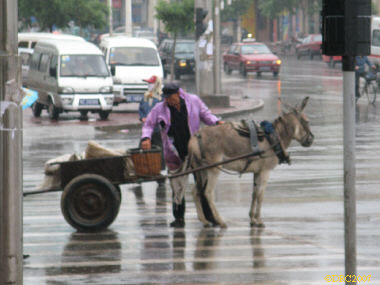
A multiple choice question on, I think, the 1998 AP B exam, asks about rainwater falling into a moving cart. If the rain falls vertically, does the cart speed up, slow down, or maintain constant speed? And is that because of conservation of momentum or energy? (Note that we're not considering a donkey-pulled cart, just a freely-rolling cart.)

The answer is that the cart slows down due to conservation of momentum. Mechanical energy is not conserved in this situation because much of the kinetic energy of the water dissipates as thermal energy upon splashing in the cart. And since momentum is conserved, the additional mass added by the rainwater causes the cart’s speed to drop in order to maintain the overall mass×velocity.

My students often miss the question on first pass. They’re not really sure what’s conserved and why. “Conservation of energy” is so ingrained in their consciousness – both from a physics and an environmental standpoint – that they nearly automatically choose an answer with the magic phrase.

I asked this question on my first trimester exam back in November. Anyone who missed the question had to write a test correction. Problem was, a lot of folks still made poor arguments. Some thought that energy was conserved. Some thought the cart would speed up because of the water’s initial speed – they didn’t separate vertical from horizontal momentum. I knew many of these folks were ripe for making the same mistake again.

I’m not averse to hammering an idea over and over. That’s the main idea of the “Less is More” teaching philosophy – you don’t have to assign that much work, but you must hold students thoroughly accountable for understanding everything that is assigned. So, I told the class to expect a quiz based on this question. Below is the quiz I assigned...


1. An open cart on a level surface is rolling without frictional loss through a vertical downpour of rain. As the cart rolls, an appreciable amount of rainwater accumulates in the cart. Thus, the cart and water can be treated as if they are colliding.

(a) Which of the following is conserved in this collision? Circle all that apply.

Kinetic energy
momentum
velocity
acceleration


(b) What is the horizontal velocity of the rainwater before it lands in the cart?


(c) What will happen to the speed of the cart? Explain in one or two sentences.


GCJ

(Top photo from donchesnut.com.)